
Most coupon sites are legitimate businesses, but many list codes that do not work. They earn a commission when you buy through their links, so a site can be “legit” and still fill its pages with expired, unchecked or made-up codes. The useful question is not whether coupon sites are legit, but how to tell which listings you can trust.
This guide explains how coupon sites make money, why so many codes fail, what is and is not risky, and the signs of a site worth using.
How Coupon Sites Make Money
Almost all coupon sites are affiliates. When you click through from the site and buy, a tracking link or cookie tells the merchant where you came from, and the merchant pays the site a commission: usually a share of the sale or a fixed fee.
- You usually pay the same price. The commission comes out of the merchant’s marketing budget, not your basket.
- The site only gets paid if you buy. That is the incentive behind pages full of codes: anything that gets a click can lead to a sale.
- Some sites also sell placements, such as featured spots, to merchants. Those should be labelled.
In the United States, the FTC expects sites to disclose these relationships clearly. A legitimate coupon site says that it earns commissions and puts that where you can see it, not only in a footer. Ours is on every store page and in our affiliate disclosure.

Why So Many Coupon Codes Do Not Work
The business model rewards having a code for every shop, whether or not anyone checked it. That leads to some common habits:
- Copied codes. Codes are collected from other sites, newsletters and forums, and nobody removes them when they expire.
- Placeholder “codes”. A button says “Show code” for an offer that is really just a link to the shop’s sale page.
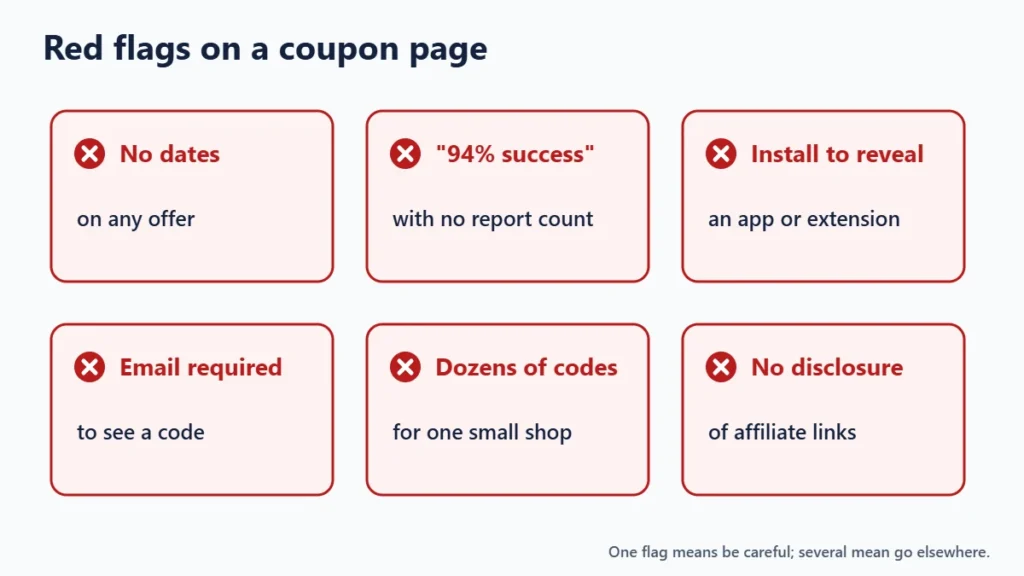
- Made-up success rates. A figure like “94% success” with no count of reports behind it means nothing.
- Codes that were never public. Some codes were meant for one customer, one employee or one partner, and the merchant cancels them once they spread.
- Real codes used outside their terms. A code can be real and still fail because it is for new customers, a different plan or another country. Our guide to why coupon codes fail covers this.
Are Coupon Sites Safe?
Using a coupon site is generally as safe as using any shopping website. The risks are specific, and you can avoid them:
| Risk | What it looks like | What to do |
|---|---|---|
| Unwanted downloads | A code is “unlocked” only after you install an app or extension | Do not install software to see a code |
| Personal data collection | You must give an email address or phone number to see a code | Skip it; real codes do not need this |
| Lookalike shops | A link goes to a domain that imitates the merchant | Check the address bar before you pay |
| Pushy pop-ups and redirects | New tabs and notifications open as you browse | Close the site, and block notification requests |
| Browser extensions | An extension that reads every page you visit can see a lot of your browsing | Install only what you need, and review what it can access |
Two things are normal, not suspicious: clicking a coupon link opens the merchant’s site in a new tab, and the link passes through a tracking address first. That is how the commission is recorded.
How to Tell a Trustworthy Coupon Site
- Every offer has a date showing when it was last checked, not just when it was added.
- The site says how it checks. “Verified” should mean something specific, such as a code applied at checkout on a stated date.
- Offer terms are shown: who it is for, what plans it covers and when it ends.
- Expired offers are removed or marked instead of left in the list.
- Success rates show how many people reported, or are not shown at all.
- You can see the code without giving anything. No email, no app, no extension.
- The affiliate relationship is disclosed near the offers.
- You can report a failed code, and there is a way to contact the site.

How Winporter Does It, Including Where We Fall Short
Since we are a coupon site, here is how ours works, so you can judge it by the same checklist.
- Every offer carries a label that says what was checked and when. “Verified” means an editor applied the code at the merchant’s checkout and it was accepted. “Checked” means the offer was confirmed on the merchant’s own site, email or affiliate feed, without a checkout test. The full method is on our How we verify page.
- On 12 November 2026 we listed 35 offers from 33 stores. Only 1 was checkout-tested (Verified); the other 34 were source-checked (Checked). 31 of the 35 were deals that need no code, where the price is shown on the merchant’s own site, and only 4 were codes. Still, it means most of our labels say Checked, not Verified.
- Labels go stale after 30 days without a new check, and offers leave the list when they end or fail a check.
- Visitor reports need at least 10 responses before a success rate appears, and each connection can report once per offer per month.
- Commission is not part of how offers are ranked. Editor’s picks get a small, limited boost.
- Stores with no working offer say so, instead of showing old codes.

If an offer from Winporter fails for you, answer “Did this code work?” on its store page or tell us through our corrections page.
Frequently Asked Questions
Are coupon sites scams?
Most are not. They are affiliate businesses paid by merchants. The common problem is unreliable listings, not fraud. Be wary of any site that asks you to install software or hand over personal details to see a code.
Why do coupon sites have so many codes that do not work?
Because listing a code costs nothing and any click can earn a commission. Without a checking process, expired and unofficial codes pile up.
Do coupon sites make you pay more?
Normally no. The merchant pays the commission. If a price looks higher after you click through, compare it with the merchant’s site opened directly.
Is it safe to click coupon links?
Generally yes. A coupon link passing through a tracking address before the merchant’s site is normal. Check that you end up on the merchant’s real domain before you pay.
What does “verified” mean on a coupon site?
It depends on the site, which is why it matters whether the site explains it. On Winporter, it means an editor applied the code at checkout on the date shown.
The Bottom Line
Coupon sites are mostly legitimate, but their listings vary a lot in quality. Trust the ones that date every offer, explain what “verified” means, show the terms, disclose how they earn money, and never ask you to install anything. Then confirm the final price at checkout, whichever site you use. You can browse Winporter’s stores with those checks in mind.
