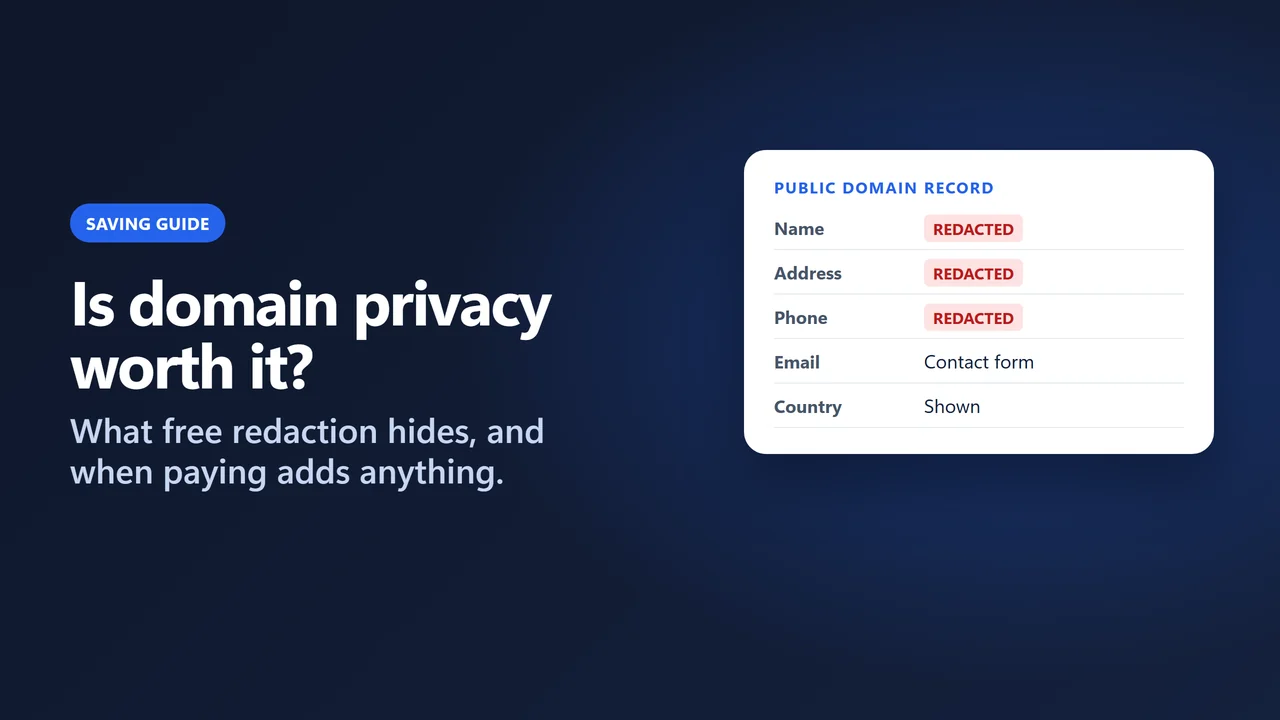
Is domain privacy worth it? Yes, but it is rarely worth paying for. Many registrars now hide your name, street address, phone and email from public lookups at no charge, and several say privacy is included free. Since 21 August 2025, ICANN’s Registration Data Policy sets what registrars must hide for generic domains such as .com, and a newer lookup system, RDAP, is now required for all of them (only .com, .name and .post must still run the old WHOIS too). Pay only if your registrar doesn’t hide your details for free, or if you want the few fields that still show (such as your country and state or province) replaced by a provider’s details.
This guide shows what a public domain record reveals today, what free redaction covers, what a paid privacy service adds, and when to skip it.
Key takeaways
- For generic domains, registrars must hide your name, street, postal code and phone wherever they redact data, and replace your email with a contact form or relay address.
- Your country is always shown, and your state or province is shown if the registrar collected it. A privacy service replaces those with its own details.
- Porkbun, Cloudflare Registrar and Hostinger say privacy or redaction is free on domains that allow it; Squarespace says it is included.
- .us domains can’t use privacy services: the .us policy prohibits them.
- Privacy isn’t anonymity. In a domain dispute (UDRP), a privacy provider can reveal who you are.
What Domain Privacy Is (and What Changed)
Every domain has a public registration record. For years it was read with WHOIS, and it listed the owner’s name, address, phone and email, which is why registrars started selling privacy add-ons. Two changes matter now:
- RDAP replaced WHOIS. ICANN says that since 28 January 2025 registries and registrars for generic domains are “no longer required to provide WHOIS” (except .com, .name and .post) and must provide RDAP, a newer lookup system. You can look up any record with ICANN Lookup at lookup.icann.org.
- Redaction became a written rule. ICANN’s Registration Data Policy “is effective on 21 August 2025”. Registrars and registries must hide personal data where the law requires it, and may also hide it for a commercially reasonable purpose. Many registrars hide it for every customer, but the policy doesn’t require that everywhere, so check your own record.
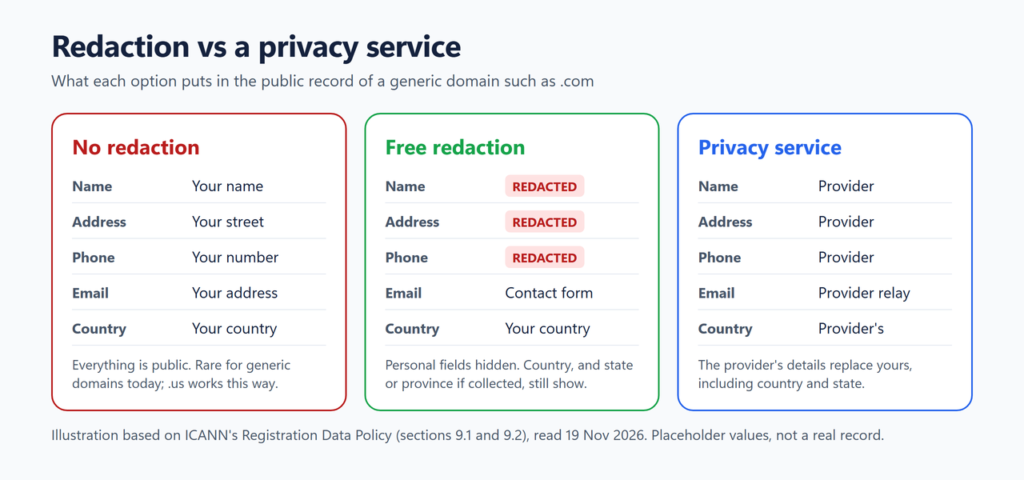
So “domain privacy” now means two different things. Redaction is the registrar leaving your personal fields out of the public record. A privacy or proxy service is a product that puts a provider’s details in the record in place of yours.
What a Public Domain Record Shows Today
When a registrar applies the policy’s redaction rules to a generic domain (.com, .net, .org and the newer extensions), this is what a public lookup shows:
| Field | Public lookup | Rule in ICANN’s policy |
|---|---|---|
| Name, street address, postal code | Hidden | Registrars must redact them (9.2.2.1) |
| Phone and fax numbers | Hidden | Registrars must redact them (9.2.2.1) |
| Email address | Replaced | A contact email or web form that doesn’t reveal your address (9.2.3) |
| City | May be hidden | Redaction is optional (9.2.2.4) |
| Organisation (company name) | Shown if you agree; otherwise may be hidden | If you enter an organisation at all, it is treated as the domain holder (6.6, 9.2.6) |
| State or province | Shown | If the registrar collected it (9.1.4) |
| Country | Shown | Always published (9.1.5) |
| Registrar, dates, name servers, status | Shown | Must be published (9.1) |
The email rule is the one most people miss. Your email address is hidden, but people can still reach you: the policy says the registrar “MUST Publish an email address or a link to a web form” that doesn’t reveal your address. Expect some spam through that form or relay, as with any public contact route. If you agree to publish a field, the registrar must then publish it, so only consent to what you want public.

What a Paid Privacy Service Adds
A privacy or proxy service replaces what’s left in the record with the provider’s details. ICANN’s registrar agreement separates the two:
- Privacy service: you stay the registered name holder, and the provider’s contact details are shown instead of yours.
- Proxy service: the provider becomes the registered name holder and “licenses use” of the domain to you. Read the provider’s terms before you use one for a domain your business depends on: if the agreement says the provider registers the domain and licenses it to you, it is a proxy service.
Where the privacy or proxy service is affiliated with the registrar, the policy says the registrar must publish “the full Registration Data of the Privacy or Proxy Service”. Your state or province and country no longer appear; the provider’s do. That is the main thing such a service adds over free redaction.
Registrars That Include Privacy for Free
These registrars say on their own websites that privacy or redaction is free or included:
| Registrar | What its own site says |
|---|---|
| Porkbun | “WHOIS privacy is free on every domain whose extension allows it”; it “stays free every year you renew” |
| Cloudflare Registrar | Offers “personal data redaction on WHOIS for free”, where the registry permits it; state/province and country still show |
| Hostinger | “For supported extensions, Hostinger automatically includes free privacy protection” |
| Squarespace Domains | “WHOIS privacy is included for all eligible domains” |
Other registrars and hosts sell privacy as a paid add-on, sometimes bundled with other services such as malware scanning. If an add-on appears in your cart, check whether the privacy part is free at another registrar and whether its price changes at renewal. Our guide to why the price is higher at checkout covers how add-ons get into a cart, and web hosting with a free domain explains what a bundled domain includes after the first year.

Where Domain Privacy Doesn’t Help
.us domains
The usTLD Privacy Services Policy prohibits anonymous or proxy registrations for .us, and registrars may not use their own contact details in place of yours. Porkbun’s .us page says the extension “does not allow WHOIS privacy and does not redact”. Your details are public on a .us domain.
Domain disputes
Under the rules for UDRP, the process used for trademark complaints about domains, the domain is locked for the whole case, and the record can be updated with your real details through “a request by a privacy or proxy provider to reveal the underlying customer data” early in the case. Registrars must also publish how to request hidden data, and ICANN’s Registration Data Request Service passes requests to registrars that take part in it. Privacy reduces spam and casual lookups; it doesn’t make you anonymous.
Transfers
ICANN’s Transfer Policy has no requirement to turn privacy off before you move a domain. What matters is the transfer lock (your registrar must remove it, or let you, within five calendar days of a request), your authorisation code, and the 60-day windows after registration or a previous transfer in which a registrar may deny a transfer. Some registrars ask you to switch privacy off as part of their own process; follow their instructions.
Is Domain Privacy Worth It? A Quick Decision Guide
| Your situation | Verdict | Why |
|---|---|---|
| Your registrar redacts for free (check the record) | No need to pay | You already have the main protection |
| You want your state or province hidden as well | A privacy or proxy service can help | It publishes the provider’s details instead of yours |
| The add-on bundles other things (malware scans, backups) | Judge each part separately | Privacy itself is often free elsewhere |
| You register a .us domain | Privacy isn’t available | The .us policy prohibits it |
| You run a business that wants to be contactable | Often skip it | Consent to publish your organisation instead |
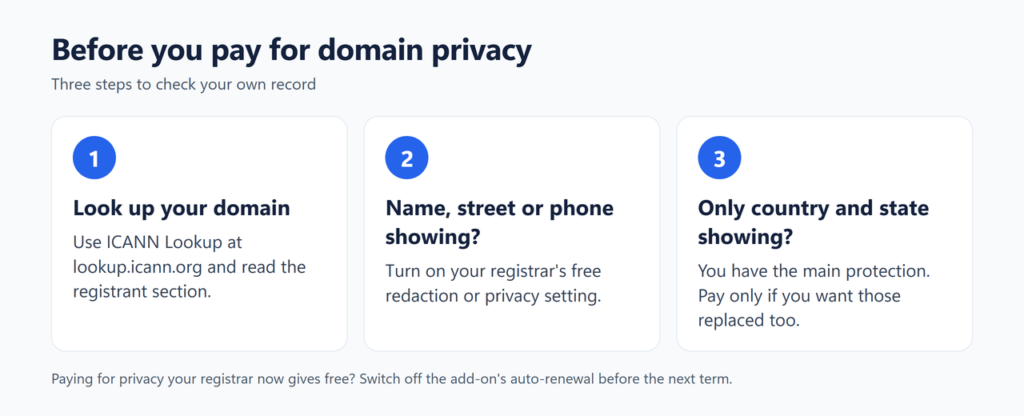
How to check your own domain in three steps
- Look up your domain at lookup.icann.org and read the registrant section. For a country-code domain (.uk, .de, .in and others), use the lookup tool its registry or your registrar provides.
- If your name, street or phone appear, turn on your registrar’s free redaction or privacy setting, or ask the registrar how.
- If the record shows only your country (and perhaps your state or province), you already have what most people need. Pay for a service only if you want those replaced too.
If you already pay for privacy that your registrar now provides free, switch off the paid add-on’s auto-renewal before the next term: see how to turn off auto-renewal.
Frequently Asked Questions
Does domain privacy stop spam?
It cuts the spam that comes from harvesting public records, because your email address and phone number aren’t shown. The contact form or relay address the registrar must publish can still be used, so some messages still arrive.
Is domain privacy the same as WHOIS privacy?
Yes, registrars use both names. With RDAP now required for generic domains, “WHOIS privacy” now means hiding or replacing your details in whichever lookup system the registry uses.
Does domain privacy affect SEO?
Domain privacy changes your registration record, not your website’s content. None of the sources we checked for this guide link it to search rankings, and many established sites use it. Choose it for privacy reasons, not search.
Should a business use domain privacy?
Often not. A business usually wants to be contactable, and its address may be public already. Publishing the organisation name also makes ownership clear. Sole traders who register with a home address are the exception: check that the address is hidden.
Do I need domain privacy for a .com domain?
Not usually as a paid extra. For .com and other generic domains, registrars that apply the policy’s redaction rules hide your name, street address, phone and email. Check your record, and pay only if you also want your country and state or province replaced.
The Bottom Line
Domain privacy is worth having, but rarely worth paying for. Check your record at lookup.icann.org first. If your registrar already hides your personal details, skip the paid add-on. If it doesn’t, or you want every personal field replaced, compare a registrar that includes privacy free with the add-on price in your cart. Add domain renewals and add-ons to the running cost of your site with what a website costs per month, and browse hosting stores on Winporter for current offers. If you register a domain with hosting from a store such as Namecheap or Bluehost, check in the cart whether privacy is included or added as a paid extra. If the plan also includes mailboxes on your domain, our guide to web hosting with free email explains the limits.
Sources checked on 19 November 2026: ICANN’s Registration Data Policy (sections 6.6, 9.1, 9.2 and 10), its RDAP page, its Registration Data Request Service page, the 2013 Registrar Accreditation Agreement specification on privacy and proxy registrations, the Transfer Policy and the Rules for Uniform Domain Name Dispute Resolution Policy; the usTLD Privacy Services Policy; Porkbun’s WHOIS privacy and .us pages; Cloudflare’s Registrar product page and WHOIS redaction documentation; Hostinger’s domain search page; and Squarespace’s domains page.
