A web hosting renewal price is usually the host’s regular price, often two to eight times the first-term price. On 17 November 2026, Hostinger’s Premium plan cost $1.99 a month for the first 48 months ($95.52 paid upfront) and renews at $10.99 a month; ChemiCloud’s Starter goes from $1.49 to $11.95; Bluehost’s Starter from $3.99 to $9.99. UltaHost renews close to its first price, and InterServer charges the same renewal rate whatever term you choose.
This guide shows the renewal price for eight hosts listed on Winporter, what the jump costs over a full term, why it happens, and the practical ways to pay less when your hosting comes up for renewal.
Key takeaways
- The low monthly price is a first-term price. Most hosts renew at their regular rate, and the renewal is charged for a whole term at once.
- Of the eight hosts checked, the renewal jump ranged from 1.3× (UltaHost) to 8.0× (ChemiCloud) the first-term price.
- Renewal prices can depend on the length you renew for: Bluehost’s Starter renews at $9.99/mo on 36 months but $15.99/mo month to month.
- Coupons and sale prices usually do not apply to renewals. ChemiCloud’s terms say offers are valid for the initial term only.
- To pay less: compare the renewal price before you buy, pick the term you would renew on, turn off auto-renewal until you decide, and check whether moving hosts is cheaper.
Renewal Prices Compared
The table lists each host’s entry shared plan: the first-term price, the term that price needs, the renewal price, and how many times larger the renewal is. Click a host to see its current offers on Winporter.
| Host and plan | First term | Term needed | Renews at | Jump |
|---|---|---|---|---|
| Hostinger Premium | $1.99/mo (sale) | 48 months | $10.99/mo | 5.5× |
| Bluehost Starter | $3.99/mo (sale) | 36 months | $9.99/mo | 2.5× |
| ChemiCloud Starter | $1.49/mo (sale) | 36 months | $11.95/mo | 8.0× |
| HostArmada Start Dock | $1.91/mo (sale) | 12 months | $11.95/mo | 6.3× |
| InterServer Standard | $2.50/mo | Any, 1 to 24 months | $7.00/mo | 2.8× |
| UltaHost Starter | $2.75/mo (sale) | 24 months | $3.44/mo | 1.3× |
| FastComet Starter | $1.99/mo | Not stated | $9.95/mo | 5.0× |
| ScalaHosting Mini | $2.95/mo | Not stated | $11.95/mo | 4.1× |

Two caveats. First, Black Friday prices are temporary: Bluehost’s offer terms say the price is valid to 30 November 2026, 11:59 p.m. ET, and the other sale prices show no end date. Second, FastComet and ScalaHosting did not state on their pricing pages which term the introductory price needs, so check the cart before you rely on it.
What the Jump Costs Over a Full Term
Because hosting is paid upfront, the renewal arrives as one larger bill. Hostinger’s page says it plainly: “All plans are paid upfront. The monthly rate reflects the total plan price divided by the number of months in your plan.” The table below multiplies each monthly price by the term, for the hosts that state a term, and assumes you renew for the same length.
| Plan | Term | First term costs | Same term at renewal | Difference |
|---|---|---|---|---|
| Hostinger Premium | 48 months | $95.52 | $527.52 | $432.00 |
| Bluehost Starter | 36 months | $143.64 | $359.64 | $216.00 |
| ChemiCloud Starter | 36 months | $53.64 | $430.20 | $376.56 |
| HostArmada Start Dock | 12 months | $22.92 | $143.40 | $120.48 |
| InterServer Standard | 24 months | $60.00 | $168.00 | $108.00 |
| UltaHost Starter | 24 months | $66.00 | $82.56 | $16.56 |

Hostinger’s first 48 months cost $95.52, the figure shown on its pricing page. A second 48 months at $10.99 would cost $527.52. That is the bill that surprises people four years later. For a site you plan to keep, the useful number is the total over the years you expect to stay, not the first month.
Why Hosting Renews at a Higher Price
The first-term price is a sign-up discount, and the hosts say so in their own wording:
- FastComet: “The promotional price is for the first term only and renews at the regular rate.”
- HostArmada: “Discounts apply to your initial billing term. Renewals use the regular price.”
- ChemiCloud’s terms of service: promotional prices “apply only to the first term”, and offers are “valid for the Initial Term only and not for recurring or renewal periods.”
- Bluehost’s offer terms: “All plans renew automatically at the then-current regular rate unless canceled before renewal.”
- Hostinger’s terms say renewal fees “may be higher or lower than the fees for the initial subscription period”, and that auto-renewal is a default setting.
So the renewal is not a hidden fee: it is the normal price, and the first term was the exception. The catch is that the normal price is shown far less prominently than the sale price. Our guide to why prices rise at checkout covers the other common reasons a bill is higher than the headline.
The Renewal Term Changes the Renewal Price
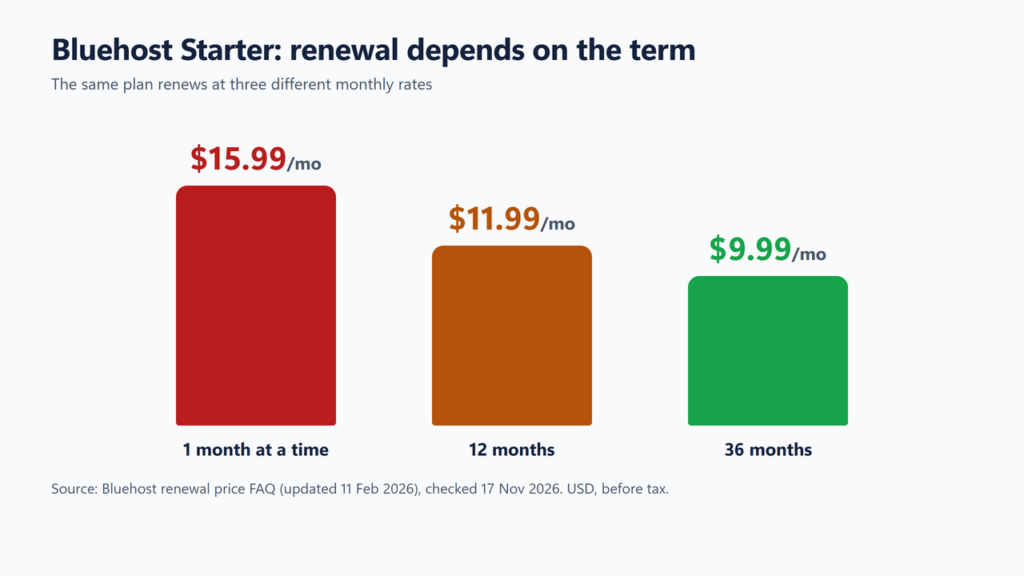
Bluehost publishes a renewal price list, last updated 11 February 2026. For the Starter plan, the renewal price depends on the length you renew for. The Business plan follows the same pattern ($13.99/mo on 36 months, $20.99/mo monthly).
| Bluehost Starter renewed for | Renewal price |
|---|---|
| 1 month at a time | $15.99/mo |
| 12 months | $11.99/mo |
| 36 months | $9.99/mo |
Bluehost’s terms also say plans renew “for successive periods of equal length as the Initial Term”, so a 36-month plan renews for another 36 months unless you change it. If you would rather renew for a different term, check your account’s billing settings or ask support before the renewal date. Our guide to monthly vs annual billing explains how to work out which length is cheaper overall.
Hosts With Smaller or Simpler Renewals
A smaller jump is worth more than a lower first month if you plan to stay. Two hosts on Winporter stood out on 17 November 2026:
- UltaHost: Starter is $2.75/mo on a 24-month term and “Renews at $3.44/mo for 2 years”. It is an unusually small jump, so confirm the renewal line in the cart before you pay.
- InterServer: the jump is not small (2.8×), but it is simple: the Standard plan is $2.50/mo on any term from 1 to 24 months and renews at a flat $7/mo (24 months: $60, then $168). Its page also shows a code, TRYINTERSERVER, for a one-cent first month.
A low renewal does not make a host better for you on its own. Compare storage, the number of sites, backups and support too. It does make the long-term cost easier to predict.
How to Pay Less When Your Hosting Renews
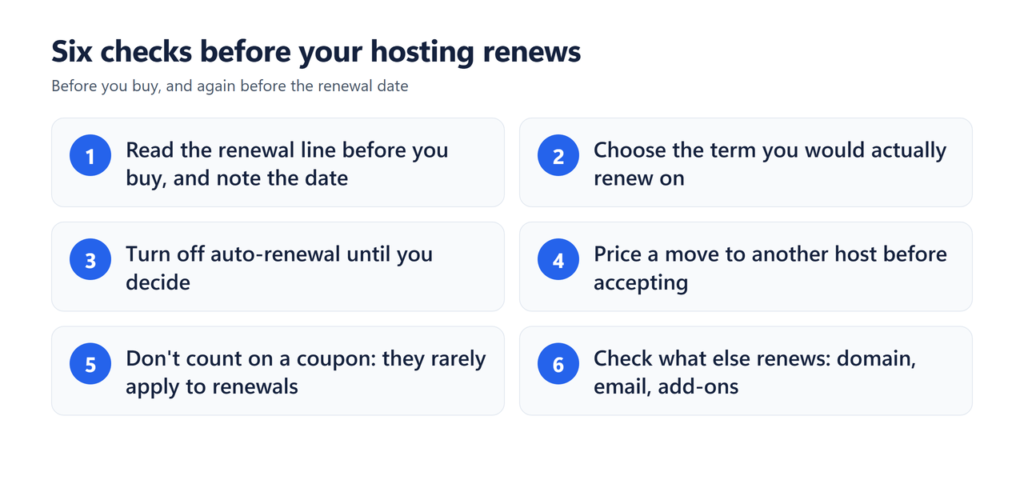
1. Read the renewal line before you buy
Five of the eight pricing pages checked print it under the sale price (for example, “Renews at…”). Write it down with the renewal date. If the page does not show it, the cart or the host’s terms usually do. Already a customer? Log in to your host’s billing or services area: the renewal date and price are usually listed against the plan.
2. Choose the term you would actually renew on
A long first term locks in the low price for longer, but it also means the renewal arrives as a large bill. If you would renew for a shorter term, check that term’s renewal rate now, as with Bluehost above.
3. Turn off auto-renewal until you decide
Auto-renewal is usually on by default, and hosts such as ChemiCloud bill the card on file automatically. Switching it off gives you time to compare prices, but if you forget, the plan expires and your site can go offline. Set a reminder a few weeks before the date, and see our guide to turning off auto-renewal for when to leave it on.
4. Price a move before you accept the renewal
New-customer prices are usually a host’s lowest prices. Moving can save money, but it takes time, and your domain and email may need moving too. Many hosts move sites for free: see web hosting with free migration.
5. Don’t expect a coupon to work on a renewal
Coupons are usually for new purchases. ChemiCloud’s terms state it outright, and the other hosts say their discounts cover the first term only. A renewal coupon offered by a third-party site should be treated with suspicion unless the host’s own page confirms it.
6. Check what else renews
A free domain is usually free for the first year only. HostArmada’s promotions agreement says a free domain “will not be renewed for free”. Count the domain renewal, any email service and the add-ons you chose at checkout. Our guide to hosting with a free domain explains what that offer covers.
If You Have Already Been Charged
Money-back guarantees usually cover the first purchase, not renewals. Hostinger offers refunds within 30 days of purchase, and Bluehost says it gives no refunds after 30 days. ChemiCloud’s terms allow renewal refund requests within 7 days of the renewal date for shared hosting, and monthly renewals are non-refundable. Contact the host straight away, quote the renewal date, and ask what they can do. Our guide to getting a refund for a subscription walks through the steps.
Frequently Asked Questions
Why is my web hosting renewal so expensive?
Because the first term was discounted. The renewal is charged at the host’s regular price, and for a long term it is billed upfront, so the bill can be several times larger than the first one.
Can I keep the introductory price when my hosting renews?
Usually not. The hosts checked here describe their sale prices as first-term only. UltaHost renews close to its first price, and InterServer renews at a flat $7/mo on any term.
Can I use a coupon code on a hosting renewal?
Rarely. Codes are typically for new purchases. ChemiCloud’s terms say promotional offers are not valid for renewal periods.
Does a longer hosting plan renew for the same length?
Often, yes. Bluehost’s terms say plans renew for periods equal to the initial term, and Hostinger’s pricing page says its plans renew “for the same term”. Check your billing settings or ask support if you want a different renewal term.
Do laws stop hosting companies raising renewal prices?
Generally, no rule we found caps the renewal price itself. The rules that exist mostly cover how auto-renewal is disclosed and cancelled. In the US, the FTC’s own pages describe its 2024 “click-to-cancel” amendments as vacated; in March 2026 it published an advance notice asking whether and how to amend the rule, and no replacement rule was listed on 17 November 2026. Rules differ by country and state.
The Bottom Line
Judge a hosting plan by its renewal price and term as well as its first month. Note the renewal date, turn off auto-renewal until you have compared prices, and price a move before you accept a large renewal. Browse all stores on Winporter to see each host’s current offers, their terms and when they were last checked.
Sources checked on 17 November 2026: the pricing pages of Hostinger, Bluehost, ChemiCloud, HostArmada, InterServer, UltaHost, FastComet and ScalaHosting; Bluehost’s renewal price FAQ and terms of service; Hostinger’s universal terms of service; ChemiCloud’s terms of service; HostArmada’s promotions agreement; and the US Federal Trade Commission’s negative option rule pages.
